The $400-Billion Bombshell: Danielle Smith Finally Admits What Albertans Were Never Supposed to Hear

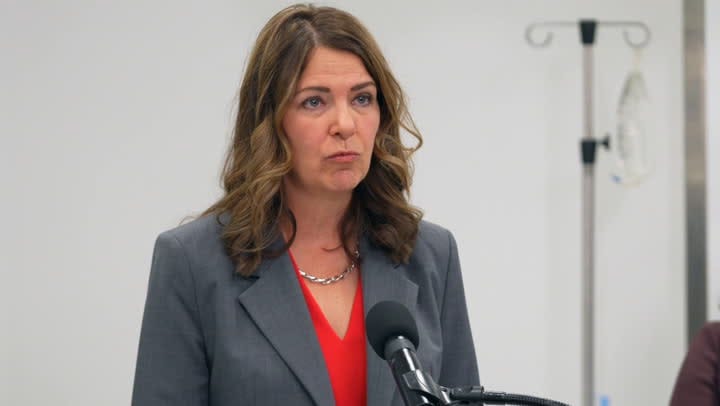
For years, Alberta’s separatist movement sold a fantasy.
A fantasy of effortless independence. A fantasy of instant prosperity. A fantasy that Alberta could simply walk away from Canada, keep all its wealth, avoid the hard consequences, and somehow emerge richer, freer, and stronger.
Now, in a stunning moment of political honesty, Premier Danielle Smith has admitted what many economists, constitutional scholars, business leaders, Indigenous leaders, and ordinary Albertans have understood all along:
Separation would come with a staggering price tag.
According to Smith herself, an independent Alberta could face nearly $400 billion in transition costs and another $25 billion to $50 billion every year in ongoing expenses. Her government acknowledges trade agreements would have to be renegotiated and massive new state institutions would need to be built from scratch.
The obvious question is this:
Why are Albertans only hearing this now?
After months of town halls, petitions, separatist rallies, social media campaigns, and endless rhetoric about Alberta “going its own way,” why is the premier only now publicly discussing numbers that fundamentally alter the entire debate?
Because these costs were never a secret.
Anyone paying attention knew independence would require Alberta to create its own international trade apparatus, customs agency, border services, diplomatic corps, passport system, defence arrangements, currency framework, regulatory agencies, pension administration, tax collection infrastructure, treaty negotiations, international recognition strategy, and countless other institutions currently shared through Confederation.
None of that comes cheap.
Yet much of the separatist grift movement spent years pretending these realities either did not exist or could somehow be brushed aside with slogans and bumper-sticker nationalism.
Now the premier herself is effectively confirming that the economic consequences could be among the largest financial disruptions in Alberta’s history.
And suddenly the conversation has changed.
The timing is impossible to ignore.
Only after a referendum question has been approved.
Only after political tensions have been inflamed.
Only after separatist organizers have spent months convincing supporters that independence would be a straightforward path to prosperity.
Only after the issue has become one of the defining political controversies in Canada.
Now comes the fine print.
Now comes the disclaimer.
Now comes the warning label.
The irony is difficult to miss. For years, critics of separatism were mocked as fearmongers whenever they raised concerns about investment flight, constitutional chaos, treaty obligations, trade uncertainty, debt division, pension liabilities, and the enormous costs of establishing a new country.
Today, those same concerns are being echoed by the very premier who put Alberta on the path toward this referendum.
What makes the situation even more extraordinary is the reaction from some separatist activists.
Instead of reconsidering the viability of the project, many are already arguing that the costs are worth paying or dismissing them entirely. Some claim Alberta’s resource wealth would quickly offset the losses. Others insist the numbers are exaggerated. Still others argue that independence is about emotion, identity, and sovereignty rather than economics.
But that raises an uncomfortable reality.
If the movement is no longer primarily about economics, then Albertans deserve honesty about that too.
Because the original sales pitch was overwhelmingly financial.
Albertans were told they were being robbed.
They were told independence would make them richer.
They were told Ottawa was the source of virtually every problem.
Now that the premier herself is discussing costs that could approach half a trillion dollars, the argument appears to be shifting from “this will make us wealthier” to “this will be expensive, but we should do it anyway.”
Those are very different propositions.
Meanwhile, polling continues to show that most Albertans remain opposed to separation. Even amid years of political conflict and Western alienation, support for leaving Canada has generally remained well below a majority.
That reality may explain why the economic details have been so politically inconvenient.
The more Albertans learn about the actual mechanics of separation, the less attractive the idea tends to become.
Questions emerge quickly.
Who assumes Alberta’s share of Canada’s national debt?
What happens to pensions?
What happens to Indigenous treaties that predate Alberta itself?
What happens to international trade access?
What currency does Alberta use?
How many companies relocate headquarters during years of uncertainty?
How many investment projects are delayed?
How many jobs are put at risk while constitutional negotiations drag on for years?
These are not hypothetical questions.
They are the unavoidable realities of attempting to dismantle more than a century of Confederation.
Even Smith has acknowledged that any separation process would be enormously complicated and expensive.
Which makes the greatest political mystery of all why these realities were not front and centre from the very beginning.
Albertans deserved to know the price before the sales pitch.
Instead, many are only now discovering the size of the bill after the political contract has already been signed.
The result is a referendum debate increasingly defined by a question that should have been asked months ago:
If separation could cost Alberta hundreds of billions of dollars, trigger years of uncertainty, require endless negotiations, and divide the province from itself, why did it take so long for the government to start talking about the consequences?
Because the most dangerous political movements are often built on what they leave out.
And the biggest number in Alberta politics today is not the 300,000 petition signatures.
It is not the referendum date.
It is not even the number of separatist supporters.
It is $400 billion. And Alberta only has a current population of 4,368,370 people, so do the math.
A figure so enormous that it exposes the gulf between the fantasy Albertans were sold and the reality they are only now beginning to hear.
The fantasy that no one says out loud is … SEPARTISTS do not OWN the Province of Alberta. Canadians living in Ontario dont own Ontario. SEPARTISTS can leave Alberta if they hate CANADA that much. Danielle Smith can leave FIRST, straight to Maralogo. ENOUGH IS ENOUGH.
Question for Albertans:
Why does Norway have an oil wealth fund now worth $2 _Trillion and Alberta doesn't?
Could it be the same reason that the UK does not have an oil wealth fund the same size as Norway's even though Norway and UK share the _very _same NorthSea oil field?
Alberta and UK -- both led by "Conservatives" -- sold out their oil rights for a pittance while Norway negotiated steely-eyed royalties that have amassed a fund now worth $340k per Norwegian citizen.