Danielle Smith's Constitutional Gamble: Why the UCP Is Heading for a Collision With Treaty 8 First Nations

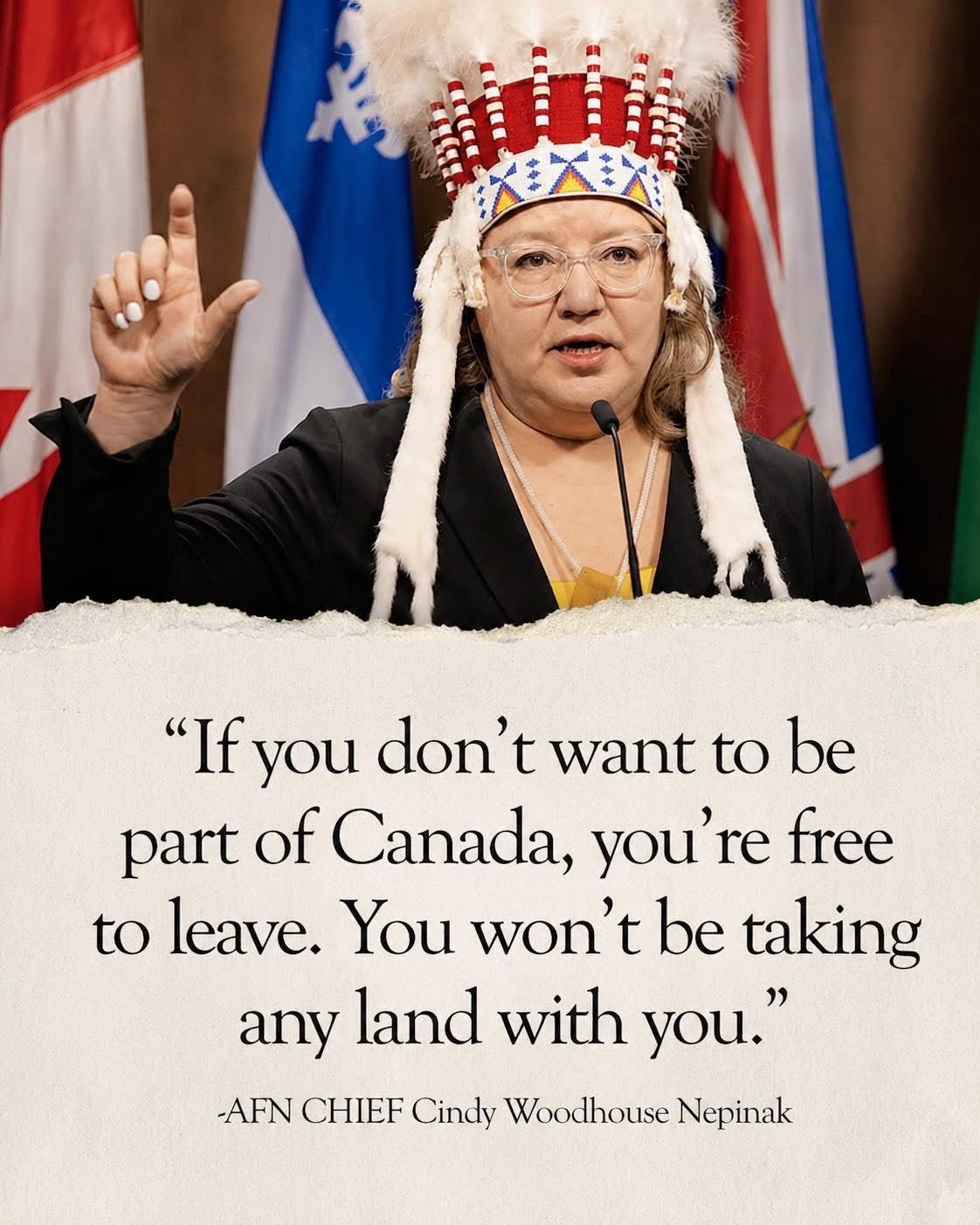
Oh Dani.
For a government that constantly speaks about respecting jurisdiction, rights, and the rule of law, Danielle Smith’s handling of Alberta’s proposed separation referendum may ultimately be remembered as one of the most reckless constitutional gambles in modern Alberta history.
The issue is no longer simply whether Alberta should remain in Canada.
The issue is whether the United Conservative Party believes it can ignore constitutional obligations when those obligations become politically inconvenient.
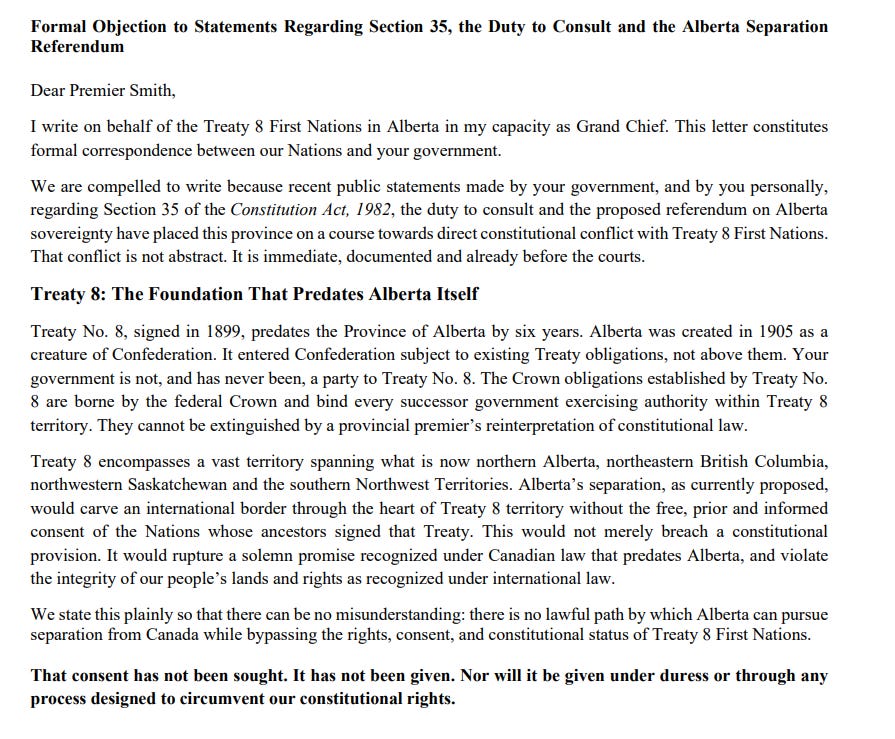
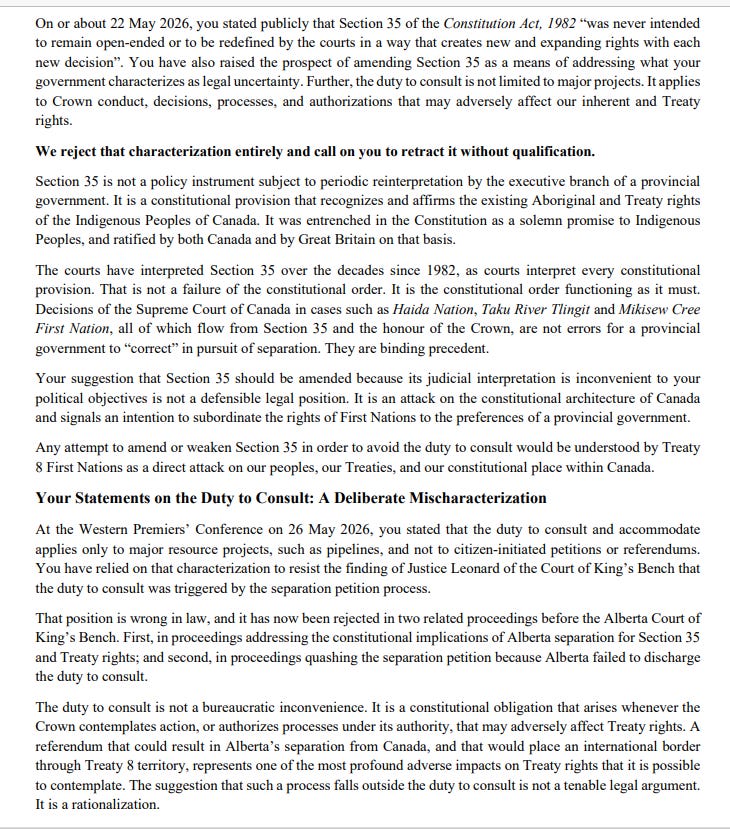
Treaty 8 First Nations have now formally warned the Alberta government that there is no lawful path toward Alberta separation that bypasses Indigenous rights, treaty obligations, and the constitutional duty to consult.
Their message was not subtle.
Their letter to Premier Danielle Smith demanded that Alberta immediately cease any attempt to proceed with a separation referendum or any related process until meaningful consultation and accommodation obligations have been fulfilled.
The response from the government appears to be: proceed anyway.
That decision is extraordinary.
A Treaty Older Than Alberta Itself
One of the most damaging aspects of the government’s position is that Treaty 8 leaders are not making a political argument.
They are making a constitutional one.
Treaty 8 was signed in 1899.
Alberta did not exist until 1905.
As the Treaty 8 letter bluntly points out, Alberta entered Confederation subject to existing treaty obligations. It did not inherit the authority to rewrite them.
The province exists within a constitutional framework that recognizes and affirms Indigenous and Treaty rights under Section 35 of the Constitution Act, 1982.
These are not policy preferences.
They are constitutional commitments.
Yet Smith has repeatedly suggested that courts have expanded Section 35 beyond its intended purpose and has publicly discussed the possibility of amending the provision.
That position has triggered outrage among Indigenous leaders because it sounds less like constitutional analysis and more like frustration that constitutional protections stand in the way of political objectives.
When governments begin talking about changing constitutional rights because courts have interpreted them in ways they dislike, alarm bells should be ringing everywhere.
The Courts Have Already Spoken
This is where the situation becomes particularly troubling for the UCP.
Treaty 8 is not simply warning about a hypothetical legal problem.
The Alberta government has already been challenged in court.
Justice Shaina Leonard ruled that Alberta failed to fulfill its duty to consult regarding the separation petition process and found that Indigenous rights could be adversely affected by such a process.
That ruling was not a political opinion.
It was a judicial finding.
The government’s answer has effectively been to argue that the courts got it wrong.
Every government has the right to appeal a decision.
But there is a difference between appealing a ruling and behaving as though the constitutional concerns identified by the court simply do not exist.
The more the government minimizes those concerns, the more it risks appearing dismissive of both Indigenous rights and the constitutional framework that governs the province.
Consultation When Convenient
Perhaps the most glaring contradiction involves the duty to consult itself.
The UCP has frequently acknowledged consultation obligations when discussing pipelines, energy projects, industrial developments, and resource extraction.
Yet when confronted with a process that could potentially alter Canada’s borders, redefine jurisdictional authority, affect treaty relationships, and transform the constitutional structure under which Treaty rights operate, the government suddenly argues consultation may not be required.
That argument has not impressed Treaty 8 leadership.
Nor has it convinced many constitutional observers.
If consultation is necessary when a road, pipeline, mine, or transmission line may affect Indigenous rights, it becomes difficult to explain why consultation would not be required before initiating a process that could fundamentally alter the constitutional relationship between Treaty Nations, Alberta, and Canada itself.
A Political Movement Running Into Constitutional Reality
The Alberta sovereignty movement has long thrived on slogans, frustration, and grievances.
Constitutional law is far less accommodating.
Political movements can promise simple solutions.
The Constitution rarely provides them.
Treaty 8’s letter highlights a reality that many separatist advocates appear reluctant to confront:
Alberta’s future cannot be discussed as though First Nations are merely stakeholders at the table.
They are rights holders with constitutional protections.
Their treaties are not advisory documents.
They are foundational agreements recognized by Canadian law.
Ignoring that reality does not make it disappear.
The Question Danielle Smith Cannot Avoid
The central question facing Danielle Smith is becoming increasingly straightforward:
If the courts say consultation is required, if Treaty 8 says consultation is required, and if constitutional experts continue warning about consultation obligations, why is the government still attempting to advance this process without first resolving those issues?
The answer may ultimately determine whether this referendum becomes a historic political achievement or a historic constitutional failure.
What is becoming clear is that the government is no longer merely debating the future of Alberta.
It is testing the limits of constitutional law, Indigenous rights, and judicial authority all at once.
That is a far riskier undertaking than a referendum campaign.
And it is a gamble that could leave Alberta facing years of litigation ($$$), deepening divisions with First Nations, and a constitutional crisis entirely of the government’s own making.
There is with Mrs David Smith Moretta absolute consistency we can count on.
In her mind she’s never wrong but someone else is.
Given her complete lack of any sort of experience or expertise or knowledge, with the sole exception of chasing conspiracy theories, she’d have you believe everyone else is wrong.
I stand with the Chiefs.
You know I think I can simplify my position further for clarity. If the ucp or Danielle Smith support and propose a position you will know I oppose it.
Woke since 1955 and fucking proud of that fact.
I'm 72 years of age, a life time rural Albertan. Politically, I've been a very progressive (woke) conservative most of my voting life. But over the last 5 years, I've felt more like a disenfranchised conservative. I'm alarmed at the UCP's, and Smith's, current version of far right conservatism, and their attacks on our democracy. I've never felt so uneasy about Alberta's future then I'm now. I can't remember a time when Alberta politics felt this divided and unresponsive to the majority of voters. But, I'm even more alarmed by the UCP supporters who don't recognize the UCP attacks on their democratic, and constitutionally protected, rights and freedoms, often because of their ignorance in how our Canadian democracy, or the rule of law, really works, or even worse, because they do recognize the attacks but just don't care.