Confusion, Misrepresentation and a Costco Ban: The Troubling Tactics of Alberta’s Separatist Canvassers

The Alberta separatist movement has spent months insisting it represents a grassroots surge of democratic enthusiasm. But the reality emerging from inside the campaign tells a very different story — one marked by confusion, questionable tactics, and growing warnings that canvassers may have crossed serious ethical and legal lines.
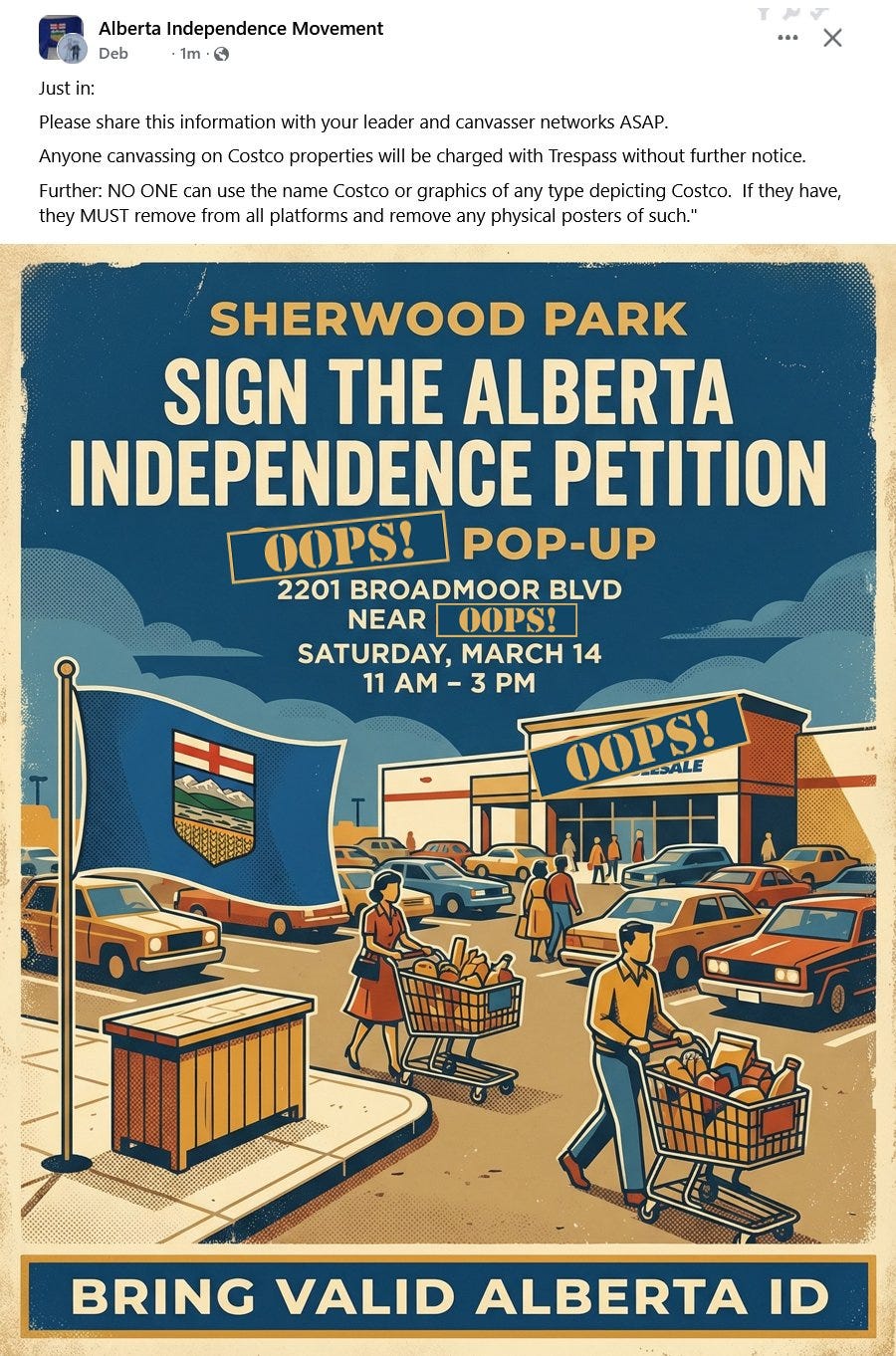
Internal messages circulating among Stay Free Alberta organizers reveal that canvassers have now been explicitly ordered not to canvass on Costco properties after the company warned that anyone doing so will be charged with trespassing.
The instruction is blunt:
“Anyone canvassing on Costco properties will be charged with Trespass without further notice.”
Just as telling is the second directive: all promotional material referencing Costco must be removed immediately, including posters, graphics and social media posts.
The reason appears obvious. Campaign materials were openly advertising petition pop-ups in locations framed as being near or associated with Costco stores — creating the impression of legitimacy and high-traffic locations tied to a major retailer.
That illusion has now collapsed.
A Campaign Struggling to Control Its Own Canvassers
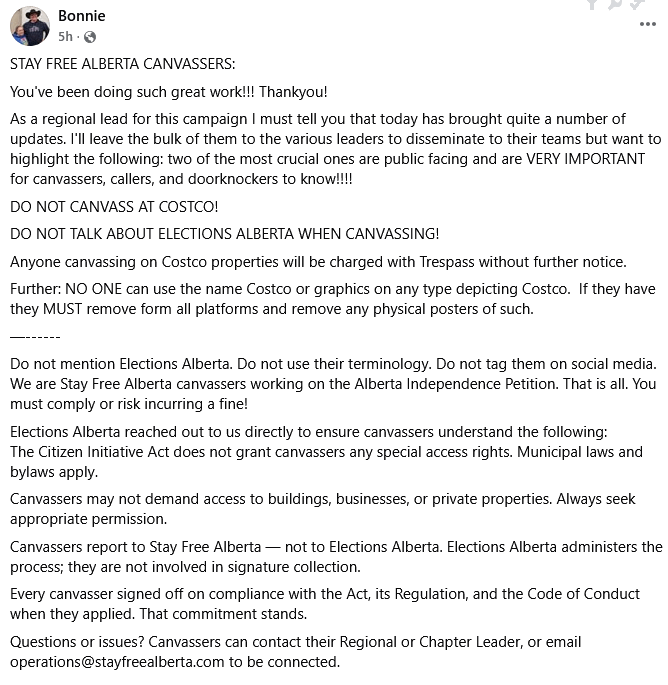
Perhaps even more revealing is the second instruction circulating among organizers: canvassers must not talk about Elections Alberta.
The directive could hardly be clearer:
“DO NOT TALK ABOUT ELECTIONS ALBERTA WHEN CANVASSING!”
“Do not mention Elections Alberta. Do not use their terminology.”
Why would such a warning be necessary?
Because reports have surfaced that some canvassers have been telling members of the public that they are connected to Elections Alberta — the independent agency that administers provincial elections and referendums.
That claim would be misleading at best.
Elections Alberta does not collect signatures for petitions and has repeatedly stated that canvassers are not representatives of the agency. They simply administer the process once a petition is submitted.
In other words, the people gathering signatures are campaign volunteers working for political groups, not neutral election officials.
The internal message even acknowledges this reality:
“Canvassers report to Stay Free Alberta — not to Elections Alberta.”
Which raises a serious question: how many signatures may have been obtained under false pretenses?
When Misrepresentation Becomes a Legal Problem
If voters signed a petition believing the canvasser was acting on behalf of Elections Alberta, the legitimacy of those signatures could be called into question.
Democratic petition processes rely on one simple principle: informed consent.
Signatories must understand what they are signing and who is collecting their information.
Misrepresenting the authority behind a petition — particularly by implying affiliation with an official electoral body — risks invalidating that consent entirely.
At minimum, it undermines public trust in the process. At worst, it could create grounds for signatures to be challenged if a referendum attempt ever reaches Elections Alberta’s review stage.
The fact that organizers now feel compelled to instruct canvassers not to mention the agency at all suggests the problem may already have occurred.
The Costco Episode: Manufactured Legitimacy
The Costco issue also reveals another common tactic in petition campaigns: borrowing credibility from recognizable locations.
Setting up near major retailers creates a perception of legitimacy and visibility. Many people assume that if a political group is operating outside a major business, it must have permission or at least some level of approval.
But Costco’s message appears unequivocal: they did not authorize it.
Hence the immediate order for canvassers to stop.
A Movement Fuelled by Social Media, Not Structure
What these internal messages ultimately expose is a movement struggling to manage its own volunteers.
Alberta separatism has grown largely through social media networks where outrage travels faster than facts. That ecosystem rewards bold claims and emotional rhetoric — but it does not necessarily produce disciplined political organizing.
When those online networks spill into real-world campaigning, the result can be chaotic: volunteers improvising messages, misunderstanding legal boundaries, and sometimes misrepresenting their authority.
The instructions now circulating read less like strategic guidance and more like damage control.
Democracy Requires Honesty
Petitions and referendums are serious democratic tools. They allow citizens to force major political questions onto the ballot.
But that power depends entirely on public trust.
If canvassers are trespassing on private property, implying connections to Elections Alberta, or using misleading promotional materials tied to major businesses, that trust erodes quickly.
And once it erodes, the legitimacy of the entire petition effort comes into question.
For a movement claiming to represent the democratic will of Albertans, the optics could hardly be worse.
Instead of building credibility, Alberta’s separatist organizers now appear to be scrambling simply to keep their canvassers from crossing legal lines.
That is not the foundation of a serious political campaign.
It is the anatomy of a movement spinning out of control.
None of this is surprising - a group of rage posters with "renegade" tactics.....lead by the charlatans Modry and Rath....it is all laughable.
The moment I heard from friends that they’ve seen them canvassing in parking lots that’s when I knew this whole thing was cooked